
Genomic Visualizations for Japanese Poetry
If you rearrange "genomics", add/substract a few letters, you may get to "poems"

To view the comparative translation project, click the link here.
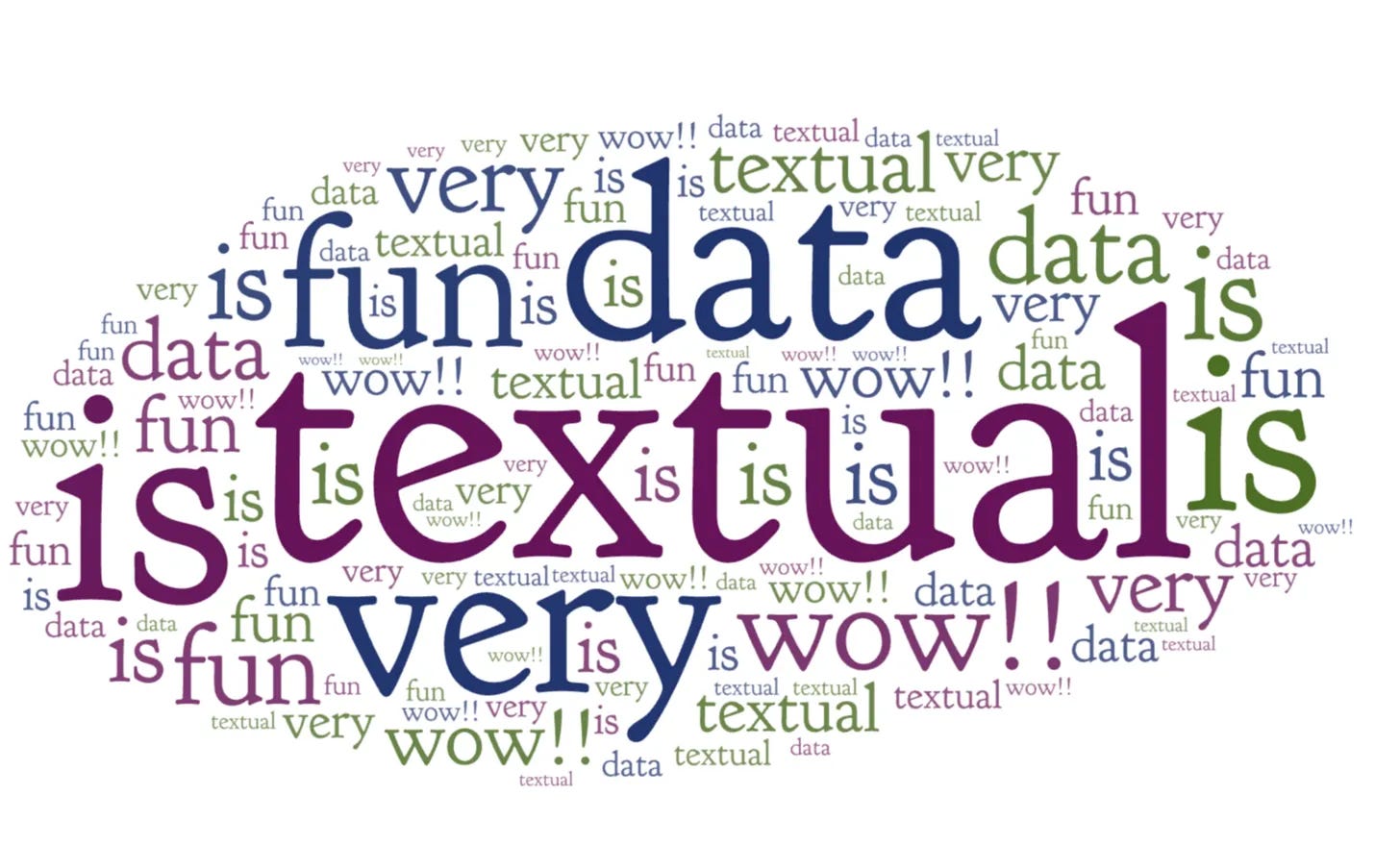
I start this post by referring to “Textual Structures”, my favorite chapter of a recent book I read titled Design for Information by Isabel Meirelles. While the majority of the 2013 book focused on various forms of quantitative data, this chapter was uniquely focused on information presented in textual format and how such data could be represented.
As the word cloud shows, I love textual information. More colloquially, I love reading, writing, being wordy, and thinking loosely about etymology. Naturally, this chapter piqued my interest.
How would you represent textual information if not for presenting the raw text itself?
The answer to this question is not clear, at least it wasn’t back in 2013. Meirelles writes of the scarcity within the methods for textual data visualization, tracing its short history back to 1999 where the first book to contain a chapter on document visualization “Using Vision to Think” by Card et al., was published.
Work on textual data analysis and visualization has the goal of finding patterns and relationships within its corpus text. Once such patterns are found, it is a matter of visualizing them in an appropriate manner.
There are several types of textual data visualizations that Meirelles shares, categorized by Marti Hearst, a professor at the School of Information at the University of California Berkeley. They are written below:
Visualizations of the connections among entities within or across documents
Visualizations of word concordances and frequency
Visualizations of the relationships of words
Reading this chapter inspired me to explore how textual data could be processed, analyzed, and eventually visualized. The rest of this post will cover just that: the motivation behind my recent textual visualization project, process, and learnings along the way.
Let’s begin by thinking over project motivation. Back in university—with “back” referring to a ripe year and a bit ago—I had worked with a professor to build some materials considering the role of translation in literary interpretation. From this research, I came to the conclusion that although we often trust the fidelity and 1-1 mapping of semantics with both human and machine translations such as Google Translate, each translation fundamentally becomes a descendant, but not an exact copy of the original. A translation is borne from the original work, but is fundamentally its own entity and different in structure, meaning, and delivery. With this thought still in mind, I determined the theme of my project: visualizing comparative translation.
The next set of questions came up naturally:
What language-to-english comparison?
What source text to analyze?
The answers to these questions would be determined with constraints in mind.
With a limited set of languages in my tool-belt, I soon decided on Japanese-to-English translations. This was my original mother-tongue and a language I knew I could get translation help from a subject expert (my mom). With no desire to run into legal issues on my personal project, I determined that the corpus of work needed to be old; it needed to be in the public domain. Not only would the original work need to be old, the translations would need to be as well, since they are covered by their own copyright.
The Ogura Hyakunin Isshu (OHI), a waka poetry anthology from 13th century Japan deemed old enough. The OHI translates to Ogura’s one hundred people, one hundred poems and contains, as the name reads, 100 poems from 100 poets. The most well-known version was collected by anthologist Fujiwara no Teika for his home near Ogura Mountain, in Kyoto. Thus the name Ogura.
Being a classical work of literature, it has been translated over a dozen times. Several translations were well past their copyright as well, and were safe to use. I decided upon four. The translators and their respective year of publishing are included as follows: Frederick Victor Dickins (1866), Yone Noguchi (1907), William Ninnis Porter (1909), and Clay MacCauley (1899/1917).
With the corpus text determined, I then embarked on understanding it.
When comparing and analyzing any form of poetry, its essential to know a bit more about it than its pure definition. At the start of this project, I was a waka novice. I’m now, passably proficient with the help of online resources. For the many who are similarly unfamiliar with it, waka poetry is a classical form of Japanese verse totals to 31 syllables and is arranged into a 5-7-5-7-7 syllable structure for each verse. These poems focus on themes such as love, and the four seasons. I include one particularly sassy example, Noguchi’s English translation of OHI’s poem 38 by Lady Ukon.
I do not mind of myself
To be forgotten by him,
But for his own life’s sake
I have to grieve.
- Noguchi, 1907
Despite some conceptions of poetry being loose and undefined, waka poetry is well defined in both structure and use of literary device!
Structurally, it is divided into an upper and lower section. The first 3 lines (known in japanese as ku) form the upper part called the kami-no-ku (5-7-5) and typically sets the scene through physical descriptions of nature. The last 2 ku form the lower part called the shimo-no-ku (7-7) and often shifts to the author’s internal reflection. Within these sections, often overlapping, is a pivot that connects observation with revelation and observation. Translations may invert this narrative structure, or add extra details to connect the two sections.
Waka poetry also employs various literary devices. These are not found in all poems, but are common and relatively standard. Most notable among them is a pivot word, called kakekotoba which is a form of word where a single phonetic word contains two meanings and often help to bridge the kami-no-ku and the shimo-no-ku. There is also makurakotoba, which translates literally to pillow word. Makurakotoba are 5-syllable epithets that are placed before specific words (eg. god, mountain) to add rhythm and evoke visual imagery. Kigo, or season words are also incredibly common. They are words associated with a specific season (eg. cherry blossoms for spring) that show the reader the time of the year without necessarily stating the season directly. There are several other literary techniques used in waka poetry, but these are the three devices that I have focused on drawing out in my analysis.
An example of a poem annotated for both structure and literary devices are included below:
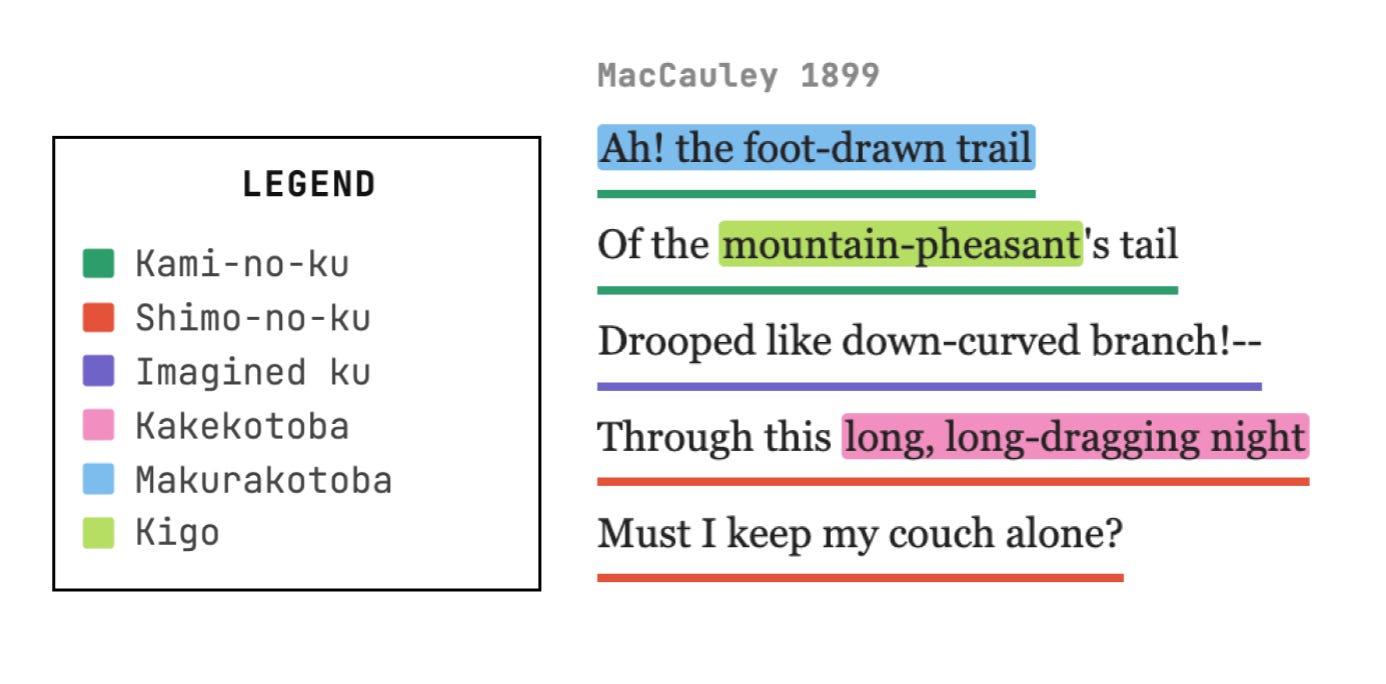
Learning about the structure and literary devices present in waka poetry, a method for analysis began to develop.
Following the upper/lower structure of waka poetry, I was curious to analyze the preservation of semantics in each section across both the original, and translations. This form of abstraction would allow a reader to quickly view preservation of structure across translators. For instance, it could help an individual see than one author tended to invert the original structure, while one maintained it. It could also help to identify insertions (lines with meanings found nowhere in the original) or deletions.
Additionally, the literary devices utilized could also be analyzed in a similar location-based manner.
With an intention in mind, I started out with a pen-on-paper approach to the analysis. I chose several poems and analyzed all four translations against the original, mapping out preservation and migration of meaning.
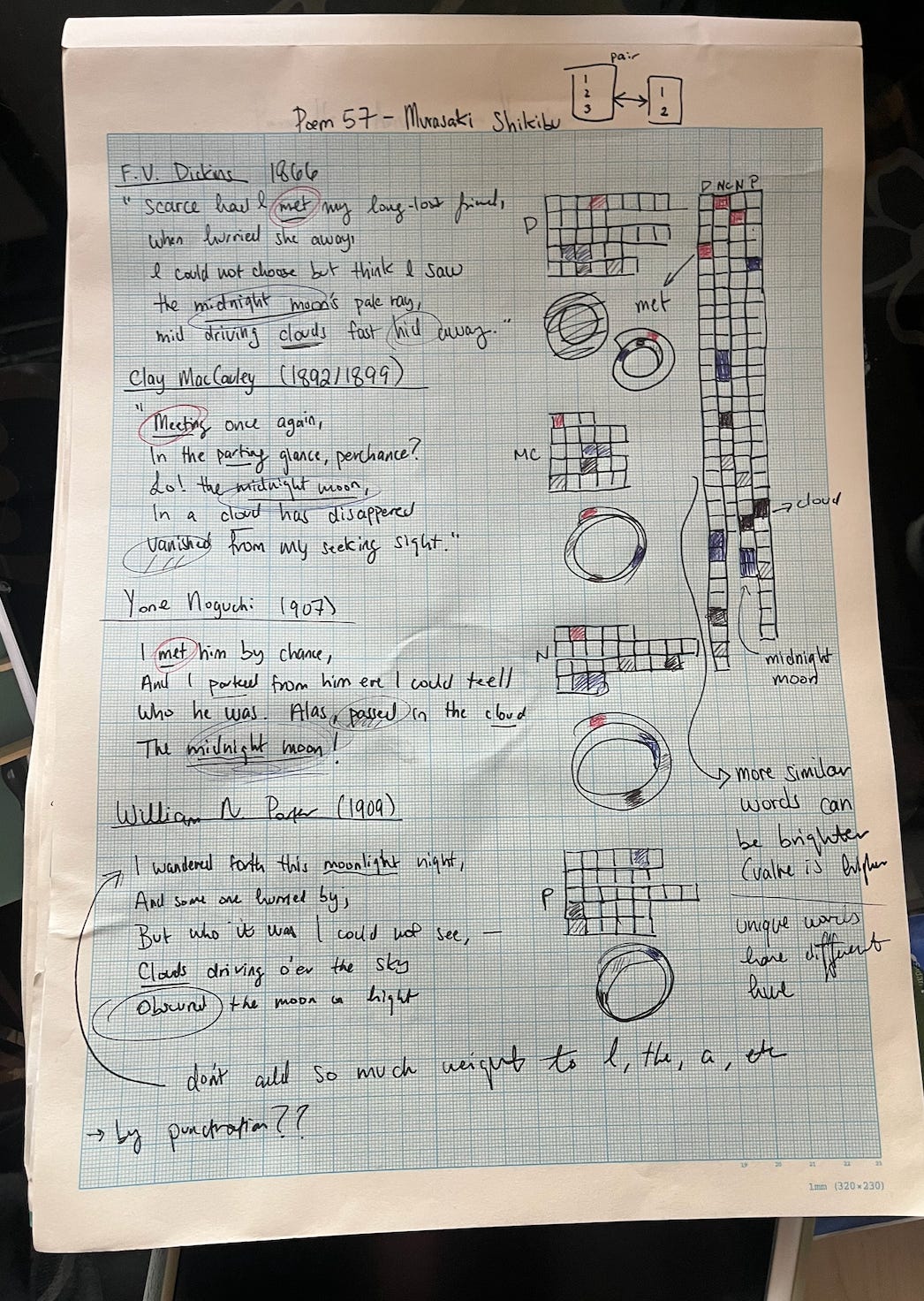
As this anthology contains 100 poems, my eventual goal was to make this manually intensive task into one that was computationally driven.
After one such graphing brainstorm, I was reminded of another colorful graph I had seen recently on Dimitar’s screen. It looked a little something like this:
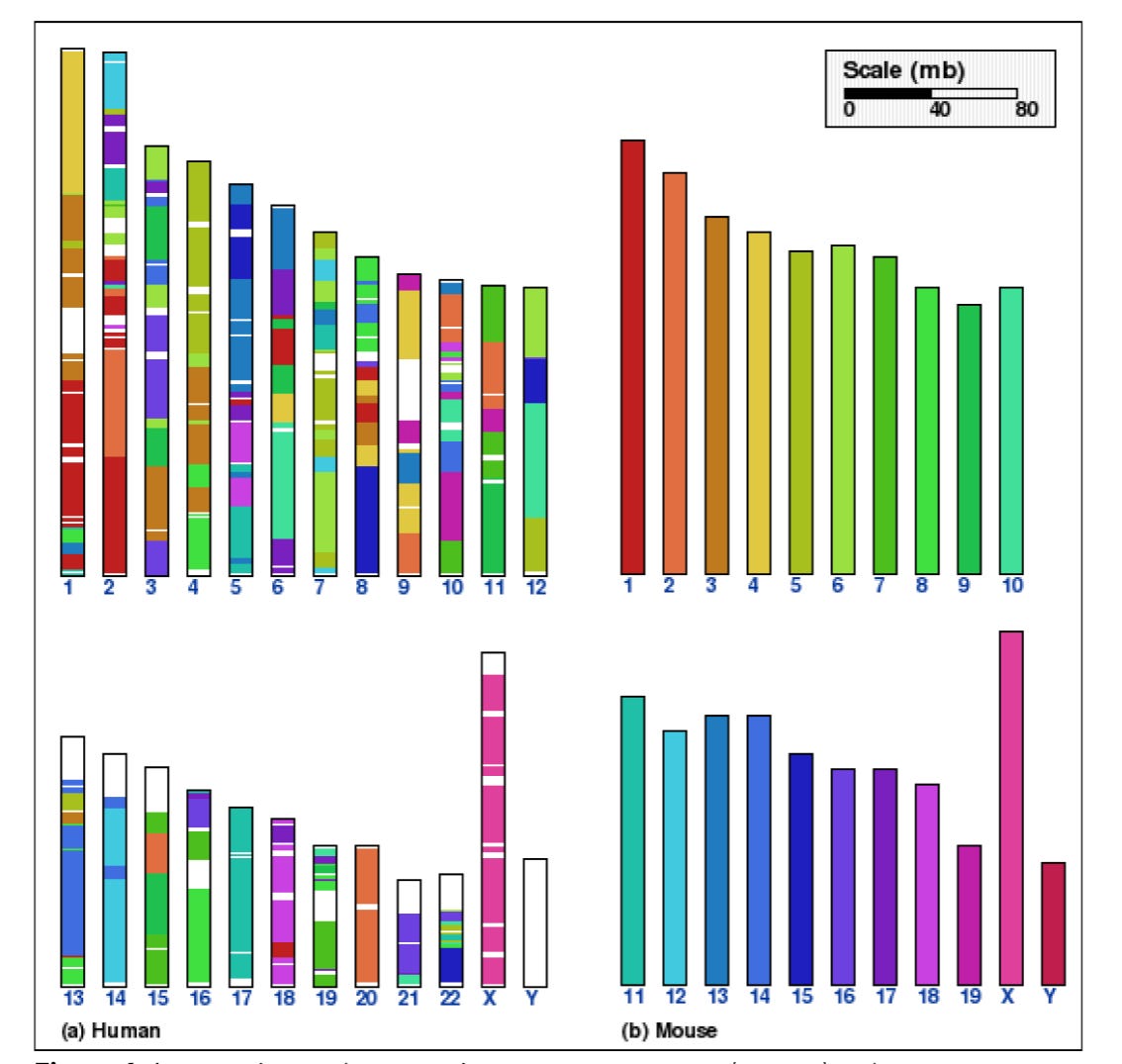
Inquiring on what I had originally called chromosome graph we were eventually able to narrow down the graph to have been a synteny graph.
If the concept of synteny is new to you, it was for me too. The premise behind it, however, is relatively straight forward and draws surprising parallels to comparative translation analysis.
Syntenic analysis is used in genomics to study the physical arrangement of DNA sequences and gene positions across species. It is a powerful tool to study the relationship between species that once shared a common ancestor. It is used to identify complex structural changes to the genome, such as rearrangements, insertions, and deletions.
Synteny is further broken down into levels: micro and macro. Macrosynteny looks at whether large blocks of genes remain on the same chromosome across species. Microsynteny is the conservation of local gene content.
I wondered if this concept could be used for my translation problem. Within comparative translations, we can liken the original work as the “ancestor gene”, and the translations as descendants that draw information from the ancestor, but rearrange and modify to reflect their language, personal biases, and cultural context.
Additionally, the levels-based approach of this scientific analogy worked particularly well for wake poetry which contains a clear structure and defined use of literary devices. Macrosynteny can be viewed as the conservation of the overall structure (kami-no-ku and shimo-no-ku). Microsynteny looks into the literary devices to understand the preservation of local content such as the kigo, and kakekotoba. Through this, we can begin to compare and contrast not only the original text to the translation, but translations against each other.
With a plan for a synteny-inspired visualization of comparative translation, the bones of the project were coming together. The rest of the project was spent figuring out details like, how to turn a manual process into a computational one and how to design the user interface and specific visuals. Sparing the full details of failed experiments and trials and errors, I’ll quickly sum up where we went from here.
The UI and visualizations were developed in Figma prior to any analysis. With an idea for the exact analyses that would take place, I mocked up what I intended the pages to be, and how users could interact with it. Despite changes that would eventually occur over the design process, the overall layout persisted through iterations of improvements. These mockups also informed the actual engineering for the site, where I used Claude Code.
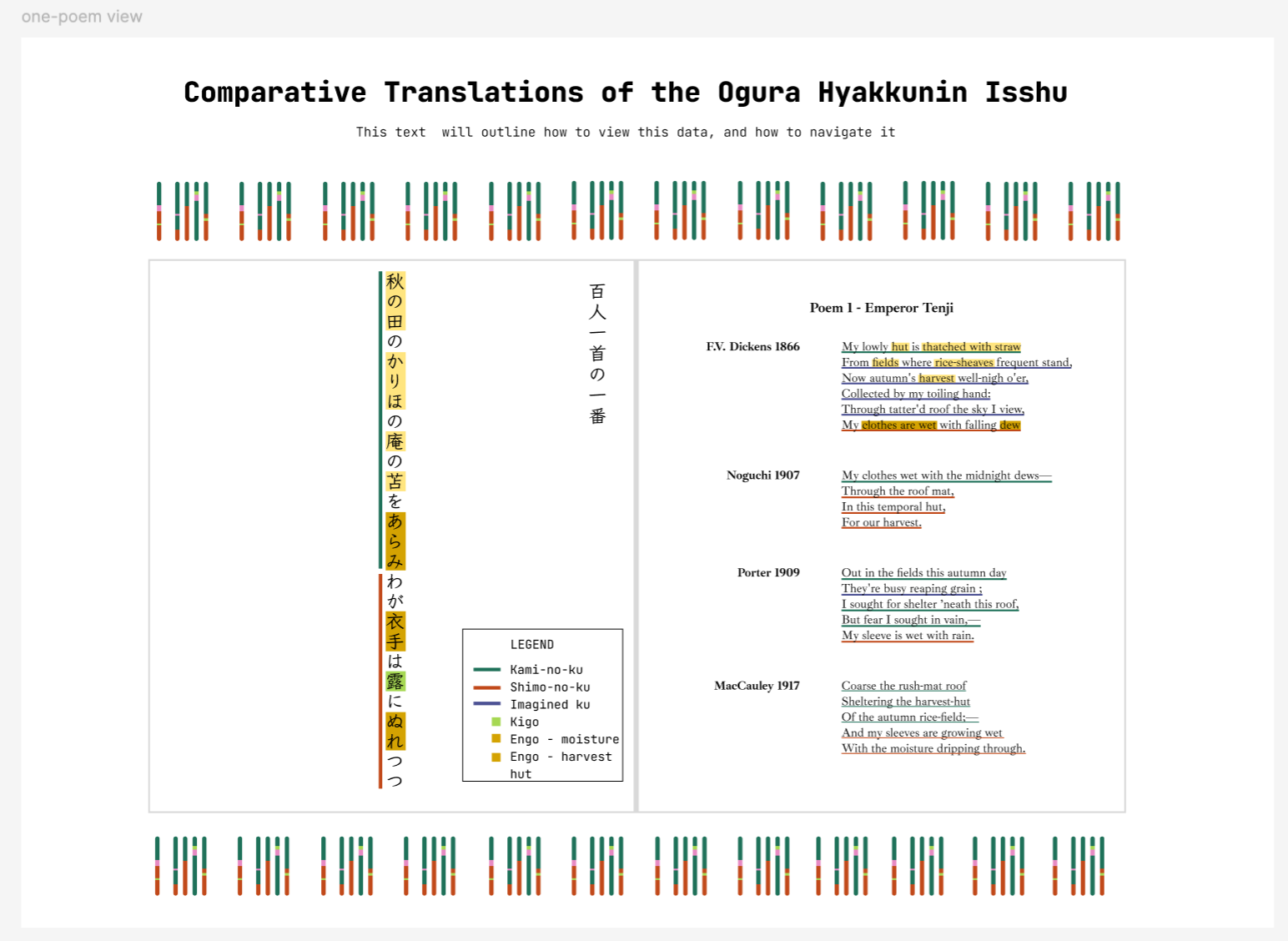
The computational handling of poems was tricky. Starting out, I wanted to make an analysis that was as robust and reproducible as possible (fearing the dreaded “slop” AI is notorious for) while managing to accurately draw out semantics from the text. This manifested into iterations of using high dimensional vector embeddings through the Global Vectors for Word Representation (GloVE) machine learning model. These worked terribly with something as complicated and archaic as both the English and Japanese I was working with. At the end of a week long exploration of deterministic(ish) models, I resolved that it was time to bring out the magic black box: LLMs.
I developed a thorough prompt to classify and map sections of the poems. This prompt would classify the upper and lower levels, as well as the literary devices in each poem. The results were immediately better; not perfect of course, but better.
In order to maximize accuracy and reliability within LLM classification, I added a second, human evaluation step. As mentioned earlier, my mom—who previously worked formally as a translator between Japanese and English—was brought in to this project for extra validation.
With the great annotation on its way, we spent a week sitting down during evenings to annotate and correct classifications made by the LLM through a review site I made with Claude Code.
After completing annotations for all poems, as well as tweaking the site design, the final (for now) visualization is available to view here. I’ve included a short video walk through as well.
Before ending this post I want to mention a few caveats.
This project wasn’t a user research driven project. It was driven by a personal motivation to continue to learn information design, play with textual data, and better understand what the capabilities of data visualization are within a field such as comparative translation. It is not meant to big and grand, but rather, curious and hopefully, informative.
As mentioned earlier, this project used AI for site development and classification tasks! I know AI use is very contested across fields, including the information design field. Understandably so; AI-ed information design tends to suffer in both underlying though and structural data rigor. However, it also helps an individual to build and prototype creatively and quickly. Whether you agree with my utilization of AI or not, I worked to make it suit my learning needs as I focused on developing the design and process, rather than line-by-line code. I explain my usage and reasoning more in the about page of my site. Feel free to take a look!
Annotations are human, and therefore up to interpretation. With my annotation officer (mom) and myself, we looked at and approved and re-classified each poem in the anthology. During this process, we made decisions such as “Is this line represented anywhere within the original text or was it made up?” and “Is the english wording of ‘fisherwomen’ close enough to the original that referred to ‘Ama’, the women divers?”. We determined the answers to these questions to the best of our ability through cross referencing academic analyses, but at the end of the day, it was simply our best judgement. Keep this in mind when viewing the poems!
Finally, after all of this, I looked up and a month had passed, 100x5 poems had been analyzed, and through it all I had splashed around in the great lake of textual visualization.
Through this splashing, floundering, and diving, I continue to learn that this data lake is deep. A simple question becomes more complicated once you get closer to it. Execution always takes more than anticipated. But the process is fun, and what a joy it is to have fun while learning.
For more about the details about the project without the long winded process details, feel free to check out the about page of the project.